Top 5 Strongest Currencies in the World and Likely Performance in 2026
❤️ Spread the Love
Even if the dollar is the number one currency in international trade, there are quite a few less popular currencies that are much more expensive than the dollar. Currencies have become a main signal of economic stability during a time when inflation is becoming cooler, interest rates are changing, and there are still uncertainties in the world. The article presents the strongest five currencies and their expected performance in 2026, thus making it easier for investors, travelers, and finance students to figure out where the risk-free area is.
What Makes a Currency Strong?
A currency that is strong does not mean it is the most popular or widely used forex across the globe. Rather, it indicates that it has the largest purchasing power among the currencies. The strongest currencies, after analyzing worldwide financial and forex market research, have been proven to be determined by a few important factors:
- Interest rates: Higher and stable interest rates lure in foreign capital
- Inflation control: Keeping inflation low ensures maintaining the purchasing power
- GDP and exports: Strong economies make currencies stronger
- Political and fiscal stability: Good governance elicits confidence
- Foreign exchange reserves: They serve as a cushion during economic crises
Top 5 Strongest Currencies in the World (2026)
The top 5 strongest currencies in the world rankings are based on exchange value against the US Dollar, consistently supported by Forbes, Wise, and Western Union.
-
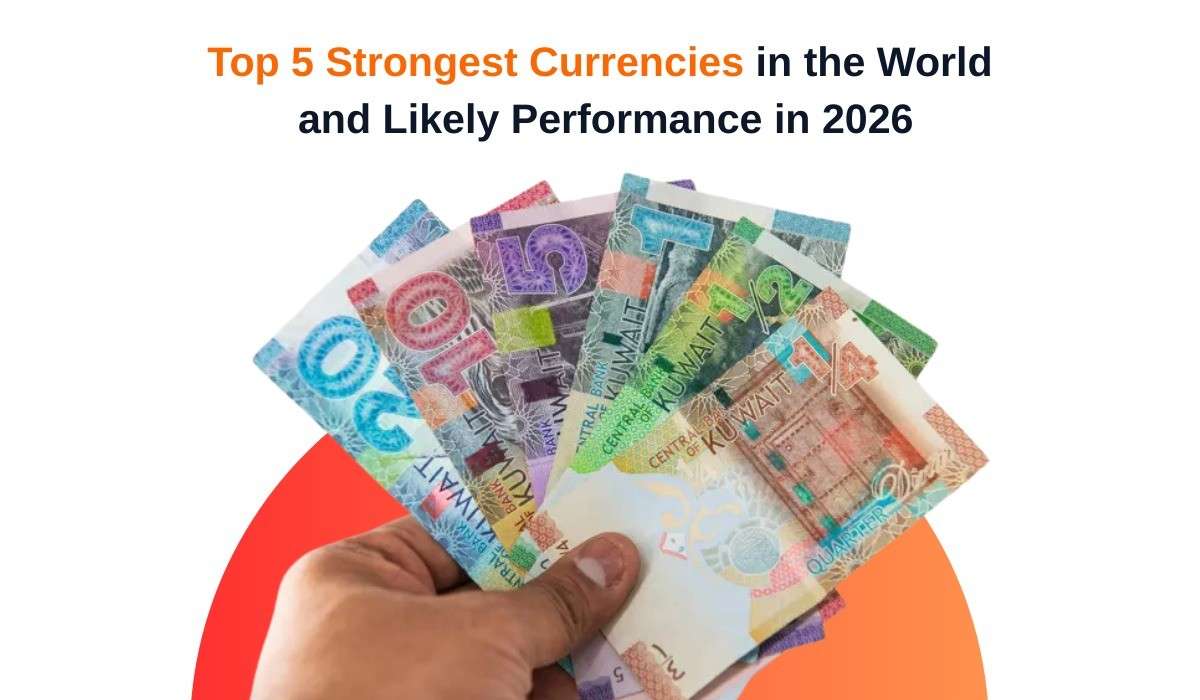
Kuwaiti Dinar (KWD)
The Kuwaiti Dinar (KWD) is widely regarded as the world’s strongest currency by value. Its strength is underpinned by Kuwait’s oil-rich economy, substantial foreign exchange reserves, and disciplined monetary governance. Unlike currencies pegged to a single unit, the KWD is linked to a basket of currencies, allowing stability while limiting excessive volatility.
Kuwait also maintains low inflation levels and strong fiscal buffers, supported by sovereign wealth investments and prudent government spending. These structural strengths provide long-term resilience to the currency.
2026 Outlook:
The Kuwaiti Dinar is expected to remain stable in 2026, with minimal volatility. Sound fiscal management, ample reserves, and steady oil revenues are likely to continue supporting its value.
-
Bahraini Dinar (BHD)
The Bahraini Dinar (BHD) is among the world’s highest-value currencies and is firmly pegged to the US Dollar, ensuring long-term exchange rate stability. Bahrain’s fixed exchange rate regime reduces currency risk and supports investor confidence. Unlike many oil-dependent economies, Bahrain benefits from a diversified economic base, with financial services, banking, and regional trade acting as the primary stabilizing forces.
While oil revenues continue to support the economy, the strength and maturity of Bahrain’s financial sector play a more decisive role in maintaining currency stability.
2026 Outlook:
The Bahraini Dinar is expected to remain stable in 2026, supported by its dollar peg and diversified economy. However, regional geopolitical developments may influence short-term investor sentiment.
-
Omani Rial (OMR)
The Omani Rial (OMR) is expected to remain stable in 2026, backed by its long-standing peg to the US Dollar and disciplined monetary control by the Central Bank of Oman. While domestic fiscal reforms and controlled money supply continue to support currency strength, global oil price trends will remain the most critical external factor influencing Oman’s revenue outlook and long-term economic stability.
-
Jordanian Dinar (JOD)
The Jordanian Dinar (JOD) maintains its strength primarily due to a fixed exchange rate regime and well-regulated financial institutions. Jordan has implemented long-term monetary and fiscal reforms, supported by international institutions such as the International Monetary Fund (IMF), which have reinforced currency stability and investor confidence.
Despite being a resource-poor economy, Jordan has mitigated economic pressures through strict fiscal discipline, foreign financial assistance, and strong international partnerships. Additionally, the dinar’s limited global trading volume reduces exposure to speculative pressure, helping preserve stability.
2026 Outlook:
The Jordanian Dinar is expected to remain moderately stable in 2026, supported by ongoing reforms, disciplined fiscal management, and continued backing from international partners.
-
British Pound (GBP)
The Pound Sterling (GBP) of the United Kingdom is the strongest floating currency on this list. Unlike pegged currencies, the pound’s value is determined by market-driven forces of supply and demand, making it more responsive to global economic conditions.
One of the key pillars of the pound’s strength is London’s position as a global financial hub, supported by deep and liquid capital markets, a robust banking system, and strong institutional credibility. These factors help sustain long-term confidence in the currency despite periodic fluctuations.
However, as a freely floating currency, the pound is more sensitive to inflation trends, interest rate decisions, and political developments compared to pegged currencies.
2026 Outlook:
The Pound Sterling is expected to remain volatile yet fundamentally strong in 2026, with its resilience supported by the UK’s mature financial infrastructure and global market relevance.
Strongest Currency vs Most Used Currency
Many people confuse the strongest currency in the world with global dominance.
- Strongest currency: Measured by exchange value (KWD, BHD, OMR)
- Most used currency: Measured by trade and reserves (USD, EUR)
| Currency | Value Strength | Stability | Global Usage |
| Kuwaiti Dinar | Very High | High | Low |
| Bahraini Dinar | Very High | High | Low |
| Omani Rial | High | High | Low |
| British Pound | Moderate-High | Medium | High |
| US Dollar | Moderate | High | Very High |
Likely Currency Performance in 2026 – Key Trends
In 2026, global currency trends will be determined by factors like inflation trends, monetary policy changes, energy market developments, and geopolitical tension. The three companies, Deloitte, IG, and RBC Global Asset Management, present different outlooks and indicate the same factors as the main drivers.
Inflation & Interest Rates
GDP growth will continue to be underpinned by disinflation in most of the major economies. This will give central banks the green light for gradual rate cuts. Upon the narrowing of policy divergence, such the support for both risky and safe currencies will be reduced.
Energy Market Influence
The fate of currencies pegged to oil will still be determined by the tendency of crude prices to be stable. Although no drastic price changes are expected, the continuous ups and downs in the energy sector will still have an effect on foreign exchange rates.
Emerging Market Risks
Emerging market currencies will not benefit from the global easing scenario and will, in fact, remain volatile due to the burden of debt issues and political risks, especially in developing nations with a high dependency on external financing.
Stability Focus
Countries backed by fiscal discipline, credible central banks, and adequate reserves are likely to provide more stability through a lower-rate environment than the highly volatile floating currencies.
Should You Invest or Hold Strong Currencies?
Holding strong currencies can serve different purposes:
- Hedging against inflation
- International travel and expenses
- Wealth preservation during uncertainty
However, strong currencies are not growth assets. Their value lies in stability, not rapid appreciation.
Conclusion
All the strongest currencies in the world have one thing in common: very strict and disciplined economic policies. The leading currencies based on oil reserves as a backing or pegging method, for instance, are at the top of the valuation list. Still, the British Pound, which is a floating currency, brings about resilience through the depth of the market.
In the run-up to 2026, the priority will be given to stability rather than speculation. The currency fundamentals knowledge will not only help the investors but also the travelers and the global citizens in dealing with the uncertainties calmly and confidently.
FAQs on Strongest Currencies
- What is the strongest currency in the world in 2026?
The Kuwaiti Dinar is expected to remain the strongest due to fiscal strength and controlled supply.
- Why is the US Dollar not the strongest currency?
Because strength is measured by exchange value, not global usage or dominance.
- Are oil-based currencies safer?
They can be stable when oil prices are steady, but they carry commodity-price risk.
- Which currency is best for long-term holding?
Stable, low-inflation currencies with strong institutions are generally preferred.
- Can currency strength change quickly?
Yes. Inflation spikes, political instability, or policy shifts can weaken currencies rapidly.
- Is a strong currency bad for exports?
Yes. Strong currencies can make exports more expensive globally.
Also, Read:
About the Author
admin
@admin
View all posts →